

AI is changing the rules of digital marketing — and UK businesses are already winning. Find out exactly how, and where to start.
The AI Marketing Revolution Is Here
In 2026, the question is no longer whether businesses should use AI in digital marketing. The question is: how quickly can you catch up if you haven’t started yet?
Across the UK, thousands of businesses — from corner-shop e-commerce brands in Manchester to fast-growth FinTech startups in London — are already using AI in digital marketing to cut costs, personalise customer experiences, and drive real, measurable results.
AI isn’t some far-off technology reserved for tech giants. Thanks to a wave of affordable, accessible tools, even small businesses can now automate tasks that used to take entire marketing teams. We’re talking about content creation, SEO, paid advertising, email marketing, social media scheduling, and much more — all being transformed by machine intelligence.
This 2026 guide is written specifically for UK businesses. Whether you’re a startup founder, a digital marketing consultant, or a seasoned agency, this resource will walk you through everything you need to know — from the core concepts to real-world applications, compliance tips, and a practical step-by-step implementation plan.
What is AI in Digital Marketing?
AI in digital marketing means using smart technology to do your marketing better, faster, and cheaper. Instead of writing every piece of content by hand or guessing which ad works best — AI figures it out for you. No more trial and error. Just results.
Traditional vs AI-Driven Digital Marketing
| Traditional Marketing | AI-Driven Marketing |
| Manual content creation | AI-generated and assisted content |
| Broad audience targeting | Hyper-personalised targeting |
| Reactive campaign adjustments | Predictive, real-time optimisation |
| Hours of manual reporting | Instant automated analytics |
| Generic email blasts | Behaviour-triggered personalised emails |
| Keyword guesswork for SEO | AI-powered keyword intelligence |
Real-world examples of AI in digital marketing include:
- AI Chatbots — Handle hundreds of customer queries simultaneously, 24/7, without a single human agent. No waiting. No missed leads.
- Predictive Analytics — Identifies which customers are most likely to buy next — so you focus your budget where it actually converts.
- Generative AI — Writes blog posts, ad copy, and product descriptions in seconds. What used to take hours now takes minutes.
- Smart PPC Bidding — Automatically adjusts your ad bids in real time to get the most conversions for the lowest cost.
- AI Email Marketing — Sends the right email, to the right person, at the exact right time — based on their behavior, not guesswork.
- AI SEO Tools — Analyze top-ranking pages and tell you exactly what to write to rank higher on Google.
- Product Recommendations — AI studies browsing habits and suggests products customers actually want — boosting average order value instantly.
Why AI is Booming in the UK Market
The UK has become one of Europe’s most active AI adoption markets. Government initiatives like the UK AI Strategy, combined with a thriving tech ecosystem in cities like London, Edinburgh, and Manchester, have accelerated the integration of AI into business operations.
Real Numbers – Real Results:
- 70%+ of UK businesses now use at least one AI marketing tool
- 30–40% cost reduction reported by UK SMEs using AI automation
- Google now rewards AI-optimized content in its ranking algorithms
- UK consumers expect personalization — AI makes it possible at scale
- Voice & visual search are growing fast — AI is the engine behind both
Key Benefits of AI for UK Businesses
Smarter Customer Insights
One of the most powerful benefits of AI in digital marketing is its ability to process enormous amounts of data and extract actionable insights — far faster than any human team could.
AI tools can analyse customer behaviour patterns, purchase history, browsing habits, and social signals to help you understand exactly who your customers are and what they want. This kind of data-driven marketing was once only available to enterprise-level companies. In 2026, it’s accessible to businesses of all sizes.
- Understand customer lifetime value more accurately.
- Identify which marketing channels deliver the best returns.
- Predict churn before it happens and re-engage at-risk customers.
Hyper-Personalization
Modern UK consumers expect personalised experiences. AI makes this possible at scale. Rather than sending the same email to 10,000 subscribers, AI enables personalisation in marketing by tailoring content, subject lines, product recommendations, and timing based on individual behaviour.
Amazon’s recommendation engine is a classic example — but this level of personalisation is now available to any UK e-commerce business through platforms like Klaviyo, Salesforce, and HubSpot, all of which have AI baked in.
Automation & Cost Efficiency
One of the most immediate benefits of AI in digital marketing for smaller UK businesses is cost savings through automation. Tasks that once required hours of human effort — social media scheduling, ad bidding, email segmentation, reporting — can now be handled automatically.
For a lean startup or a small digital marketing agency, this means you can operate with the efficiency of a much larger team without the overhead.
- Automated PPC bid management reduces wasted ad spend.
- AI content tools speed up the creation of blog posts, product descriptions, and social copy.
- Chatbots handle customer service queries around the clock.
Improved ROI
Ultimately, the role of AI in digital marketing comes down to results. Businesses using AI-driven strategies consistently report higher conversion rates, lower cost-per-acquisition, and stronger overall ROI compared to those relying on traditional methods alone.
Predictive analytics marketing tools let you forecast campaign performance before you spend a pound, while AI-powered A/B testing continuously optimises your ads, landing pages, and emails in real time.
Top AI Tools for Digital Marketing in 2026
Here are the best AI tools for digital marketing in 2026, broken down by category.
Content Creation
- Claude: Long-form content, research, nuanced copywriting, technical analysis.
- ChatGPT: Quick drafts, social copy, email sequences, brainstorming.
- Jasper AI: Marketing templates, ad copy, blog outlines, product pages.
- Copy.ai: Conversion-focused copy, sales letters, product descriptions, small business tools.
SEO
- Semrush AI: Keyword research, competitor analysis, site audits, rank tracking.
- Surfer SEO: Real-time optimization, SERP comparison, content scoring, structural audits.
- Ahrefs: Backlink analysis, keyword intelligence, site explorer, content gaps.
- RankIQ: Niche keyword research, blogger SEO, title grading, content optimization.
Social Media
- Hootsuite: Social scheduling, AI content generation, performance analytics, brand monitoring.
- Buffer AI: Social drafting, post scheduling, cross-platform publishing, engagement tracking.
- Sprout Social: Social listening, engagement tools, enterprise reporting, workflow automation.
Email Marketing
- Klaviyo: E-commerce segmentation, predictive analytics, revenue tracking, automated flows.
- Mailchimp AI: Send-time optimization, content suggestions, basic automation, audience tagging.
- ActiveCampaign: Lead scoring, complex automation, CRM integration, nurturing workflows.
Chatbots & Conversational AI
- Intercom Fin: Automated resolution, customer support, knowledge base integration, SaaS workflows.
- Drift: Lead qualification, B2B meetings, conversational marketing, pipeline acceleration.
- Tidio: Live chat, automated support, ticket management, SME-focused bots.

How UK Businesses Can Use AI in Each Marketing Channel
Understanding how to use AI in digital marketing means looking at each channel specifically. Here’s a practical breakdown.
AI in SEO
SEO is one of the areas where AI has made the biggest impact. AI SEO tools help UK businesses identify the right keywords, analyse competitor strategies, and create content that genuinely ranks.
- Use AI to identify search intent clusters — not just individual keywords.
- Tools like Surfer SEO score your content against top-ranking pages in real time.
- AI can generate meta descriptions, title tags, and schema markup at scale.
- Predictive SEO tools now forecast which topics will trend — letting you create content before the competition.
AI in PPC (Pay-Per-Click Advertising)
Google’s Performance Max campaigns are essentially AI-driven advertising — the system automatically tests ad combinations and allocates budget to what works best. UK businesses using Smart Bidding strategies have seen significant reductions in cost-per-click (CPC) and improvements in conversion rates.
- Use AI for dynamic ad copy generation and testing.
- Let machine learning optimise bidding strategies in real time.
- Use predictive analytics to anticipate when and where your audience is most active.
AI in Social Media Marketing
From content ideation to performance analysis, AI tools are transforming how UK businesses manage social media. AI can analyse which types of posts perform best for your specific audience, suggest optimal posting times, and even generate platform-specific content.
- Use AI tools to identify trending topics relevant to your industry.
- Automate responses to common social media enquiries using AI chatbots.
- Analyze sentiment around your brand to catch PR issues early.
AI in Content Marketing
Generative AI in digital marketing has perhaps had the biggest effect on content. Tools like Claude, ChatGPT, and Jasper can produce high-quality first drafts in minutes — allowing content teams to focus on strategy, editing, and originality.
However, it’s important to note: AI-assisted content still needs a human editor. Google’s algorithms are sophisticated enough to reward expertise, experience, authority, and trustworthiness (E-E-A-T). AI generates volume; humans add value.
AI in E-Commerce
For UK online retailers, AI is a game-changer. Product recommendation engines, dynamic pricing tools, and predictive inventory management all use machine learning to improve sales outcomes and reduce operational costs.
- Personalized product recommendations increase average order value.
- AI-powered search (like Search Pie or Kleve) improves on-site discovery.
- Visual search allows customers to find products by uploading images.
Real-Life UK Business Use Cases
The best way to understand AI in digital marketing examples is through real-world application. Here’s how different sectors across the UK are using AI right now.
Retail
ASOS, one of the UK’s largest online fashion retailers, has been using AI-powered recommendation engines and visual search for years. Smaller UK fashion brands are now implementing similar features through platforms like Shopify with AI plugins — giving customers a more personalised, intuitive shopping experience.
Finance & FinTech
UK challenger banks and FinTech firms like Monzo and Revolut use AI to deliver personalised financial insights to users. Marketing teams at these companies use AI to segment audiences, automate communications, and predict which customers are most likely to upgrade to premium products — a classic example of AI and machine learning in digital marketing delivering commercial results.
Healthcare
Private healthcare providers and health-tech startups across the UK are using AI chatbots to handle appointment bookings, FAQ responses, and patient triage. This frees up human staff for more complex tasks while ensuring patients get immediate answers — improving both efficiency and customer satisfaction.
Local Businesses & SMEs
You don’t need to be a corporate giant to benefit from AI. A local estate agent in Birmingham, for example, might use AI tools to automate their property listing descriptions, schedule social posts, and send personalised follow-up emails to potential buyers — all without a dedicated marketing team.
Challenges of AI in Digital Marketing
It would be dishonest to write a guide on AI in digital marketing UK without addressing the drawbacks. Here’s what to watch out for.
GDPR and Data Privacy
AI-driven marketing relies on data — and in the UK, handling personal data comes with strict legal obligations under UK GDPR (retained from EU GDPR post-Brexit). Any AI tool that processes customer data must be configured to comply. We’ll cover this in more detail in Section 9.
Cost of Implementation
While many AI marketing tools 2026 offer affordable entry-level pricing, the cost of integrating AI deeply into your stack — particularly for mid-sized businesses — can be significant. There are also hidden costs in training staff and maintaining systems.
The Skills Gap
AI tools are only as powerful as the people using them. Many UK businesses struggle to find marketers who are both creatively skilled and technically proficient with AI platforms. Upskilling existing teams is a critical challenge.
Over-Automation Risk
One of the less-discussed disadvantages of AI in digital marketing is the risk of over-automation. Brands that lean too heavily on AI — particularly for customer communications — can come across as cold, robotic, and impersonal. Paradoxically, as AI becomes more common, human authenticity becomes more valuable.
AI and GDPR in the UK
Since Brexit, the UK operates under its own version of GDPR (UK GDPR), enforced by the Information Commissioner’s Office (ICO). For any business using AI in digital marketing, compliance is non-negotiable.
Here are the key principles to keep in mind:
- Lawful basis:
You must have a valid legal reason to collect and process personal data used by AI systems.
- Transparency:
Customers must be told how their data is being used, including by AI systems.
- Right to erasure:
Individuals can request their data be deleted — your AI tools must support this.
- Automated decision-making:
Under UK GDPR, individuals have rights relating to automated decisions that significantly affect them. This is particularly relevant for AI-driven lead scoring or ad targeting.
- Data minimization:
Only collect data you actually need. AI systems shouldn’t be fed excess personal data.
Compliance tip: Before onboarding any AI marketing tool, check whether the provider offers a Data Processing Agreement (DPA) and review how they handle UK customer data.
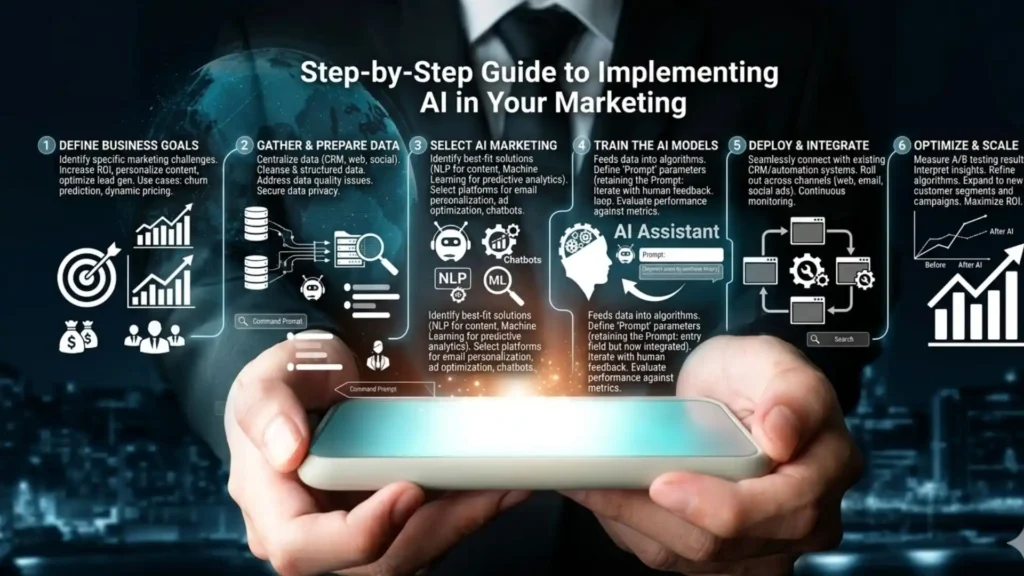
Step-by-Step Guide to Implementing AI in Your Marketing
Feeling inspired but not sure where to start? Here’s a practical, jargon-free implementation plan for UK businesses of all sizes.
Step 1 — Define Your Goals:
Before choosing any tools, get clear on what you want AI to achieve. Are you trying to generate more leads? Reduce the time your team spends on content? Improve your email open rates? Specific goals lead to better tool choices and clearer ROI measurement.
Step 2 — Audit Your Current Marketing Stack:
Look at what tools you’re already using. Many platforms (HubSpot, Mailchimp, Semrush) already have AI features you might not be using. Maximise what you have before adding new subscriptions.
Step 3 — Choose the Right AI Tools:
Based on your goals, select one or two AI marketing tools 2026 to start with. Don’t try to implement everything at once — it leads to confusion and poor adoption.
Step 4 — Organise Your Data:
AI is only as good as the data you feed it. Clean up your CRM, segment your email lists, and ensure your website analytics are properly configured. Garbage in, garbage out.
Step 5 — Start Small with Automation:
Begin with low-risk automations — like AI-generated social media captions or email subject line testing — before rolling out more complex workflows.
Step 6 — Train Your Team:
Invest in training. Even an afternoon workshop on a tool like Jasper or Semrush’s AI features can dramatically improve your team’s confidence and output.
Step 7 — Measure, Iterate, Improve:
Set KPIs before you launch any AI-driven campaign. Review performance regularly and use those insights to refine your approach. AI thrives on feedback loops.
Future Trends in AI and UK Digital Marketing
The pace of change in AI marketing is accelerating. Here’s what forward-thinking UK businesses should be preparing for.
Generative AI at Scale
Generative AI in digital marketing — the technology behind tools like Claude, ChatGPT, and Midjourney — is becoming more powerful and more integrated. By late 2026 and into 2027, expect to see AI producing fully personalised video content, interactive landing pages, and dynamic ad creative in real time.
Voice Search and Conversational AI
With smart speakers in millions of UK homes and voice-first interfaces on mobile becoming mainstream, optimising for voice search is no longer optional. AI-powered conversational marketing — where chatbots guide customers through the entire buying journey — is becoming the norm in sectors like retail and financial services.
Predictive and Intent-Based Marketing
Predictive analytics marketing is moving from campaign-level to individual-level. AI systems will increasingly be able to anticipate what a specific customer needs before they search for it — and serve them the right message at exactly the right moment.
AI + Augmented and Virtual Reality
The convergence of AI, AR, and VR is opening new frontiers for digital marketing services. UK retailers are already trialling virtual try-on experiences. Estate agents are using AI-enhanced virtual property tours. As hardware costs drop, these experiences will become mainstream marketing tools.
AI-Driven Personalised Search
Google and Bing’s AI search experiences (like Search Generative Experience) are changing the rules of SEO digital marketing. Optimising for AI-powered search results — not just traditional blue links — will be a key skill for UK SEO professionals in the coming years.
The Smartest Marketers Use Both AI and Human Skills
One of the most common questions asked of any digital marketing consultant in 2026 is: can AI replace digital marketers?
The short answer is no — but it will dramatically change what digital marketers do.
AI excels at scale, speed, and pattern recognition. It can analyse millions of data points, generate hundreds of content variations, and optimise campaigns around the clock. What it can’t do is bring genuine human empathy, cultural nuance, creative risk-taking, and strategic thinking to the table.
The most successful UK digital marketing agencies in 2026 are those adopting a hybrid model — using AI to handle the repetitive, data-heavy work while their human teams focus on strategy, storytelling, client relationships, and creative direction.
Expert Tips for UK Businesses in 2026
Here are some high-value recommendations from the frontlines of AI marketing strategy in the UK.
Prioritise data quality:
The effectiveness of every AI tool you use depends on the quality of the data behind it. Invest time in cleaning your CRM, auditing your analytics, and building a culture of accurate data capture.
Don’t skip the human review:
AI-generated content must always be reviewed and edited by a human. Especially for anything touching legal, medical, or financial topics — the stakes are too high.
Test and learn continuously:
The best AI marketing strategy is one of constant iteration. Run experiments, review results, and update your approach. Treat AI as a team member that gets smarter with feedback.
Stay up to date on UK regulation:
The regulatory landscape around AI is evolving quickly. Subscribe to updates from the ICO and keep an eye on the UK Government’s AI Office announcements.
Mix AI with authentic storytelling:
Use AI to produce more content, but let your human brand voice and authentic stories be what actually builds customer loyalty. Authenticity is the competitive advantage AI can’t replicate.
Invest in team training:
The businesses seeing the best results from AI aren’t necessarily using the most sophisticated tools — they’re the ones whose teams understand how to use what they have.
Don’t Wait — Your Competitors Aren’t
The future of UK marketing isn’t coming — it’s already here. Businesses using AI are winning. Those ignoring it are losing ground every single day.
Don’t be the business that looks back and wishes they started sooner.ClickMasters Digital Marketing helps UK businesses go from AI-curious to AI-powered — without the confusion or the overwhelm. Book your free strategy call today and take the first step.
FAQs
What is AI in digital marketing?
AI in digital marketing means using smart technology to automate tasks, personalise content, and make better marketing decisions — faster than any human team could.
How can UK businesses use AI in digital marketing?
Start with what matters most — use AI tools for SEO, content creation, email marketing, paid ads, and customer service chatbots. Every digital channel can benefit.
What are the main benefits of AI in digital marketing?
Save time, cut costs, and get better results. AI helps you understand your customers, personalise their experience, and improve ROI across every channel.
Is AI marketing legal in the UK?
Yes — as long as you follow UK GDPR rules. Be transparent about data use, get proper consent, and stay updated with ICO guidelines.
Can AI replace digital marketers?
No. AI handles repetitive work — but strategy, creativity, and human connection still need real people. The winning formula is AI plus human expertise.
What are the best AI tools for digital marketing in 2026?
Top picks: ChatGPT and Claude for content, Semrush for SEO, Klaviyo for email, Tidio for chatbots, and Hootsuite for social media.
What are the risks of using AI in digital marketing?
GDPR issues, high setup costs, team skill gaps, and over-automation. Start small, train your team, and always keep a human in the loop.